DEDALUS
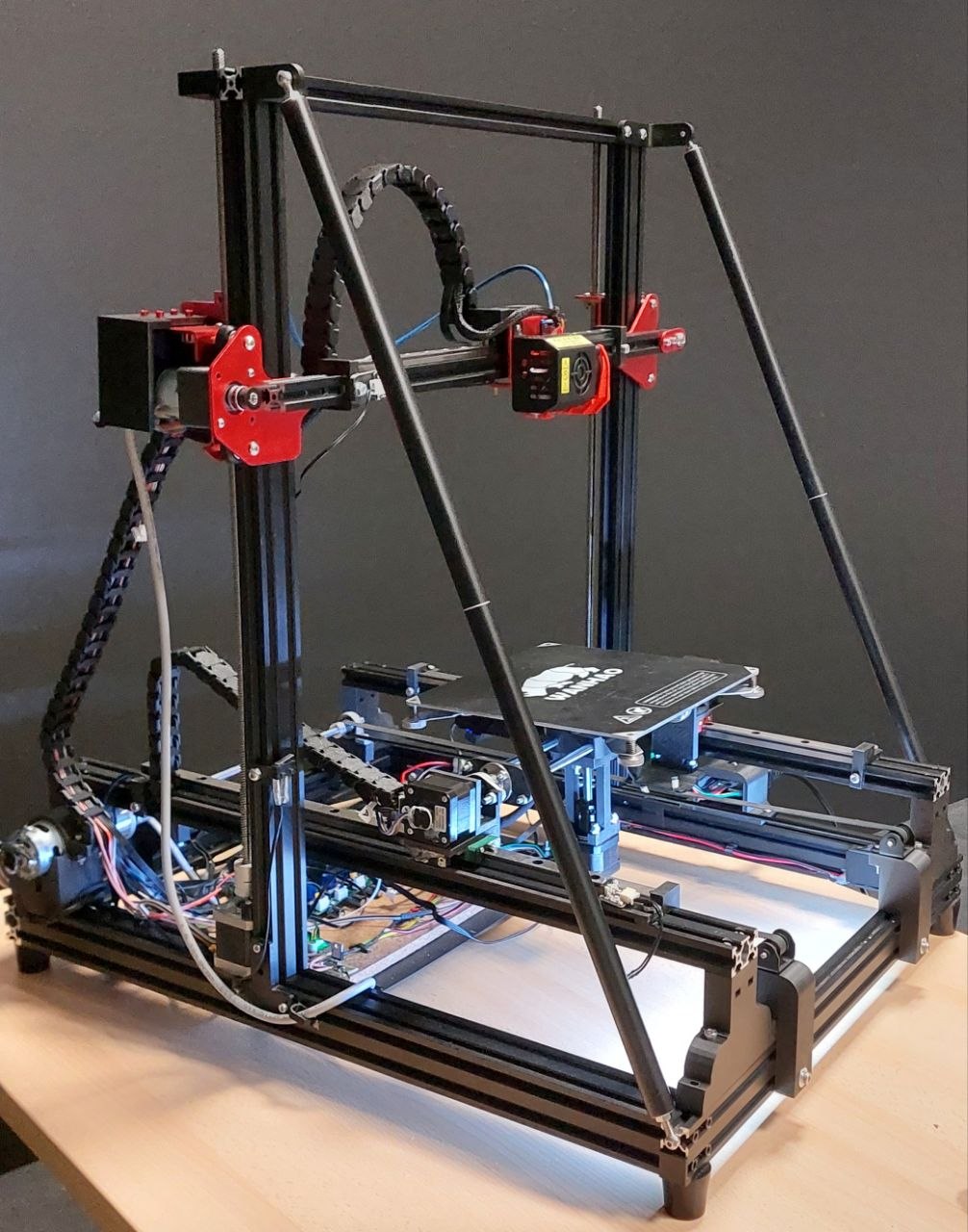
The Dedalus project focuses on upgrading a classic Cartesian 3D printer into a 5-Degree-of-Freedom (5DoF) manufacturing system. This upgrade overcomes the traditional limitations of planar Fused Deposition Modeling (FDM) by enabling non-planar printing, combining a hobbyist-friendly architecture with industrial-grade dynamic stability.
Dedalus stands on three fundamental pillars:
- Precision: Moving beyond open-loop control in favor of a closed-loop system, where position is actively measured using linear encoders rather than merely assumed.
- Decentralization: A hierarchical control architecture that separates high-level kinematic planning (delegated to a Raspberry Pi 5) from low-latency motor management (implemented on an STM32H7 ARM Cortex-M7 microcontroller).
- Mechanical Reliability: Utilizing linear rails and DC motors designed to ensure smooth and highly repeatable operations.
An integrated engineering approach drove the custom development of the entire technology stack. The low-level control board and its bare-metal firmware were designed from the ground up. By fully exploiting the microcontroller’s advanced features, data acquisition is decoupled from CPU computations, achieving highly reactive and deterministic control.
The motion planning software is also custom-built, starting from the material developed during the Precision Engineering course taught by Prof. Paolo Bosetti at the University of Trento.
Finally, a digital twin was developed from scratch and integrated with the machine’s real-world operations, applying the methodologies from the Mechatronic Systems Simulation: Modeling course taught by Prof. Francesco Biral, also at the University of Trento.